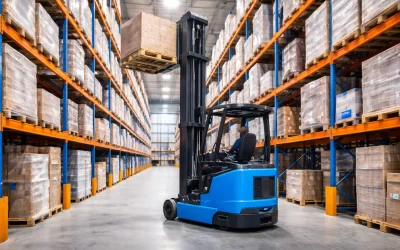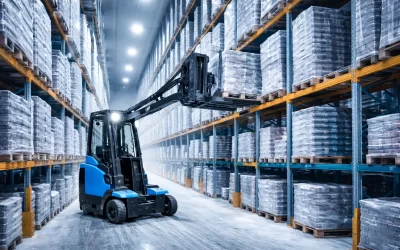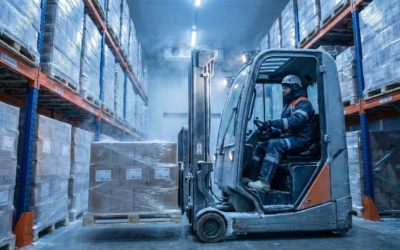
Selecting the right forklift capacity is one of the most critical decisions in warehouse and industrial operations. If the capacity is underestimated, safety risks are increased and equipment life is reduced. If it is overestimated, unnecessary capital costs are incurred.
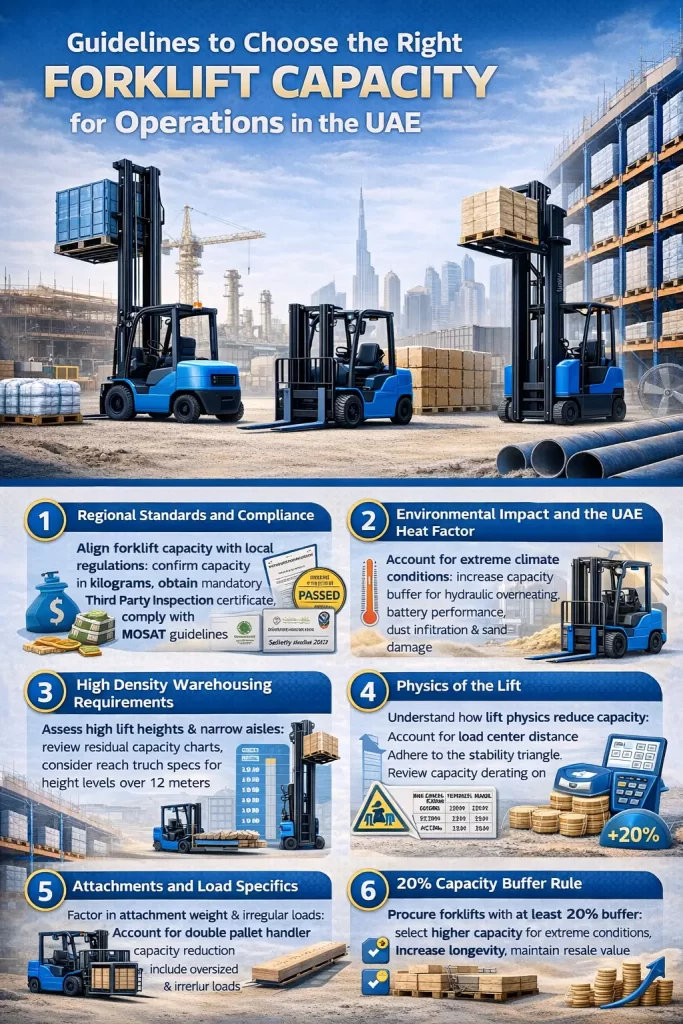
In the UAE, forklift selection must go beyond basic load weight calculations. Regional compliance standards, extreme climate conditions, high density warehousing trends, and resale value considerations must all be evaluated carefully.
This guide explains how right forklift capacity should be determined for operations in the UAE.
1. Regional Standards and Compliance in the UAE
Right Forklift capacity decisions must align with local regulations and inspection requirements.
UAE Safety Standards Beyond OSHA
While many global guides reference OSHA standards, UAE operations must comply with:
- Ministry of Industry and Advanced Technology guidelines
- Local municipality safety regulations
- Dubai Municipality Code of Construction Safety Practice
- Abu Dhabi OSHAD requirements
Forklifts used on construction sites, industrial zones, and oil and gas facilities must meet regional safety frameworks. Capacity ratings must match approved specifications.
Third Party Inspection Requirements
In the UAE, a valid Third Party Inspection certificate is mandatory for forklifts operating on:
- Construction projects
- Oil and gas fields
- Industrial free zones
Load testing is conducted during inspection. If the Right Forklift capacity plate does not align with operational requirements, certification may be rejected. Capacity selection must therefore consider inspection compliance.
Metric vs Imperial Measurement
Most international manuals list capacity in pounds. However, UAE standards are based on:
- Kilograms
- Tonnes
Improper conversion can result in serious loading errors. For example:
- 5,000 lbs equals approximately 2,268 kg
- A 3 tonne forklift equals 3,000 kg
Capacity calculations should always be confirmed in metric terms before procurement.
2. The UAE Heat Factor and Environmental Impact
Extreme climate conditions in the UAE directly affect forklift performance.
Hydraulic Efficiency in High Temperatures
During summer months, temperatures can exceed 50 degrees Celsius. In these conditions:
- Hydraulic oil viscosity may decrease
- Seal wear may increase
- Lifting efficiency may be affected
If a forklift is operated constantly near its rated capacity, overheating stress may accelerate component wear. A capacity buffer should be considered to account for thermal stress.
Battery Capacity in Electric Forklifts
High temperatures reduce battery performance. In electric forklifts:
- Charging efficiency may decrease
- Battery life cycles may shorten
- Motor strain may increase under heavy loads
If an electric forklift is selected with minimal capacity margin, overworking the motor in extreme heat can reduce lifespan. Capacity should be selected conservatively in UAE climates.
Dust and Sand Impact
In logistics hubs such as JAFZA and KIZAD:
- Sand infiltration is common
- Filters may clog faster
- Cooling systems may be compromised
A forklift operating continuously at maximum capacity under dusty conditions may experience faster degradation. The duty cycle must match operational intensity.
3. High Density Warehousing in the UAE
Modern logistics developments in Dubai South and Abu Dhabi feature high bay racking systems.
Very Narrow Aisle Requirements
In VNA environments:
- Lift heights may exceed 12 meters
- Residual capacity decreases significantly at height
A forklift rated at 3 tonnes at ground level cannot lift 3 tonnes at 12 meters. Capacity charts must be reviewed carefully.
The Reach Factor
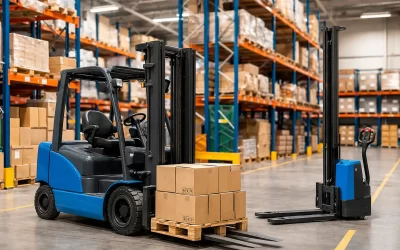
Reach trucks are commonly used in:
- Cold storage facilities
- FMCG distribution centers
- High density logistics hubs
As lift height increases, forward reach shifts the center of gravity. Residual capacity is reduced. Capacity selection must account for maximum rack height, not only ground level loads.
4. The Physics of the Lift
Understanding forklift physics is essential when selecting capacity.
Load Center in Metric Terms
Most forklifts in the UAE are rated at:
- 500 millimeters load center
- 600 millimeters load center
The load center refers to the horizontal distance from the fork face to the center of gravity of the load.
If the load extends beyond this distance, effective capacity is reduced.
The Stability Triangle
Every forklift operates within a stability triangle formed by:
- Two front wheels
- The rear pivot point
If the center of gravity shifts outside this triangle, tip over may occur. Heavier loads, elevated masts, and extended reaches increase this risk.
Capacity Derating Explained
A 3 tonne forklift does not lift 3 tonnes at maximum height.
Capacity is reduced due to:
- Mast extension
- Increased load center
- Forward tilt
The capacity plate provides a load chart. This chart must be reviewed before procurement decisions are made.
5. Attachment and Load Specifics
Forklift attachments directly affect rated capacity.
Common UAE Attachments
In beverage logistics operations such as Al Rawabi and Mai Dubai:
- Double pallet handlers are frequently used
These attachments:
- Add weight to the carriage
- Shift the load center forward
- Reduce effective lifting capacity
A forklift must be selected with attachment weight included in calculations.
Oversized and Irregular Loads
In construction and oilfield operations:
- Equipment may have uneven weight distribution
- Long materials may extend beyond forks
- Center of gravity may not be central
Such loads require higher rated capacity forklifts to maintain safe stability margins.
6. Procurement Strategy and the 20 Percent Rule
Capacity selection should not be based solely on maximum pallet weight.
Buffer for Safety and Longevity
In UAE operating conditions, it is advisable that:
- Right Forklift capacity should exceed the heaviest load by at least 20 percent
For example:
- If maximum load is 2,500 kg
- A 3 tonne forklift should be considered
This buffer accounts for:
- Heat stress
- Height derating
- Attachment weight
- Dust and operational intensity
Operating below maximum rated capacity increases equipment longevity and reduces downtime.
Resale Value Considerations
The UAE has a strong secondary equipment market. Standard capacities such as:
- 2.5 tonne
- 3 tonne
- 5 tonne
Maintain higher resale demand.
Selecting uncommon capacities may reduce resale liquidity. Procurement decisions should consider long term asset value.
Final Checklist for Choosing the Right Forklift Capacity
Before finalizing a forklift purchase, the following must be evaluated:
- Maximum load weight in kilograms
- Maximum lift height required
- Load center distance in millimeters
- Attachment weight
- Environmental operating conditions
- Regulatory compliance requirements
- Residual capacity at full lift
- Resale market demand
When forklift capacity is carefully calculated using regional compliance, environmental conditions, and operational physics, both safety and profitability are improved.
In the UAE, where extreme climate, strict inspection requirements, and high density warehousing are common, capacity selection must be approached strategically rather than based solely on catalog ratings.