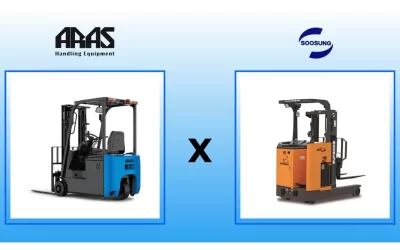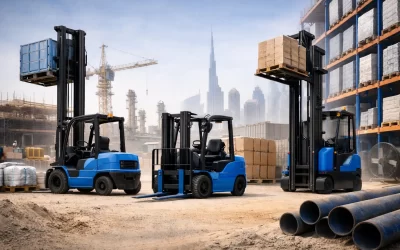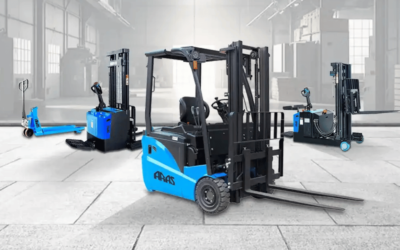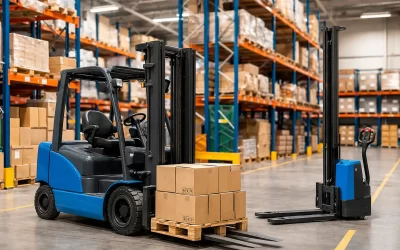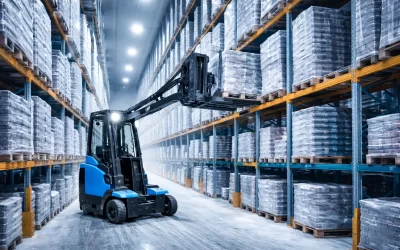
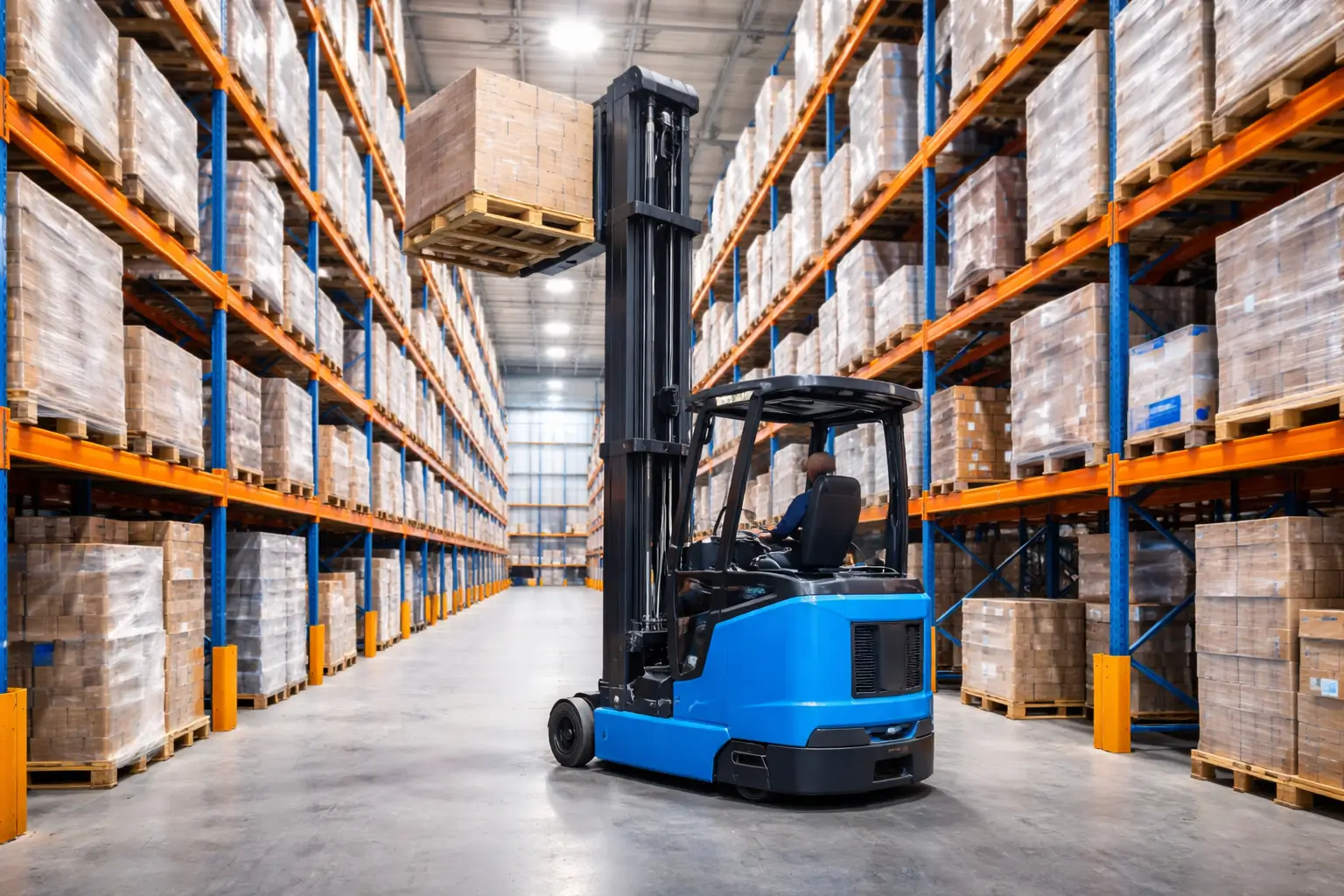
In high rack warehouses, vertical space is maximized and storage systems are extended upward to increase capacity. As inventory levels are raised and aisles are narrowed, the choice between Counterbalance vs Reach Trucks becomes a critical strategic decision. Efficiency in these environments is measured not only by lifting power but also by maneuverability, storage density, safety, and long-term operating costs.
Two of the most commonly compared material handling machines are counterbalance forklifts and reach trucks. While both are widely used in warehouse operations, their performance differs significantly in high rack environments.
Understanding Counterbalance Forklifts
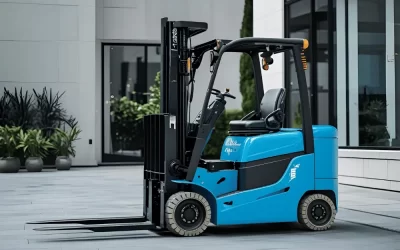
Counterbalance forklifts are among the most recognizable types of forklifts. A heavy counterweight is positioned at the rear of the vehicle. This weight balances the load that is lifted at the front, eliminating the need for additional stabilizing legs.
Key Characteristics of Counterbalance Forklifts
- A rear counterweight is used to balance loads
- Loads are lifted directly in front of the machine
- Available in electric, diesel, and LPG models
- Suitable for both indoor and outdoor use
- A wider turning radius is required
Because of their straightforward design, these forklifts are commonly used in general warehousing, loading docks, and yard operations.
Limitations in High Rack Warehouses
In high rack settings, certain operational constraints may be experienced:
- Wider aisles are required for turning
- Additional floor space must be allocated
- Lift heights may be lower compared to specialized warehouse trucks
- Maneuverability in narrow aisles may be restricted
When storage density is a priority, these factors can affect overall efficiency.
Understanding Reach Trucks
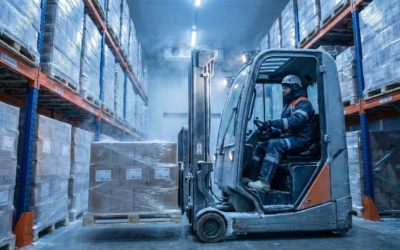
Reach trucks are specifically engineered for indoor warehouse operations where vertical storage is emphasized. A distinctive feature of this machine is its extending mast mechanism. The load is extended forward into the racking system and then retracted back toward the chassis.
Key Characteristics of Reach Trucks
- An extending mast mechanism is provided
- A narrow chassis design is used
- Electric power systems are commonly installed
- Higher lift heights are supported
- Designed primarily for indoor warehouse use
Because the load can be reached forward and pulled back, the body of the truck does not need to enter deeply into the rack area.
Aisle Width and Space Utilization
In high rack warehouses, every square meter of space is valuable, and storage density often determines operational profitability when evaluating counterbalance vs reach trucks for efficient material handling.
Counterbalance Forklifts and Aisle Space
When counterbalance forklifts are used:
- Wider aisles must be maintained
- Turning clearance must be considered
- Fewer racking rows may be installed
This can limit the total pallet positions available within a fixed warehouse footprint.
Reach Trucks and Narrow Aisles
With reach trucks:
- Narrow aisle configurations are supported
- Additional racking rows can be installed
- Higher storage density can be achieved
In facilities where expansion is not possible, the ability to reduce aisle width can significantly improve space efficiency.
Lift Height and Vertical Performance
High rack warehouses are defined by tall racking systems, and lift capability becomes a critical factor when comparing counterbalance vs reach trucks for efficient warehouse operations.
Counterbalance Forklift Lift Capacity
- Heavy loads can be handled with stability
- Moderate lift heights are typically supported
- Stability may decrease at extreme heights
These forklifts are reliable for ground-level and mid-level storage tasks.
Reach Truck Lift Capability
- Greater lift heights are supported
- Mast stability systems are integrated
- Load sway is minimized at height
- Precision placement is improved
For warehouses that store pallets at elevated levels, reach trucks are often considered more suitable.
Energy Efficiency and Operating Costs
Operational efficiency is influenced by energy consumption and long-term maintenance requirements when evaluating counterbalance vs reach trucks for warehouse operations.
Counterbalance Forklifts
- Electric, diesel, and LPG options are available
- Fuel costs must be considered for combustion models
- Ventilation requirements may increase operational expenses
- Maintenance systems are relatively straightforward
Reach Trucks
- Electric power is primarily used
- Indoor warehouse cycles are optimized
- Energy usage is generally consistent
- Specialized maintenance may be required for reach mechanisms
Over time, the total cost of ownership should be evaluated rather than only the initial purchase price.
Operator Productivity and Safety
Warehouse efficiency is strongly connected to operator performance and safety conditions.
Counterbalance Forklifts
- A familiar operation is provided
- Outdoor and indoor tasks can be handled
- Increased care must be taken in narrow aisles
- Rack damage risk may be higher in tight spaces
Reach Trucks
- Enhanced visibility features are often included
- Precision handling at height is supported
- Compact design reduces collision risks
- Faster cycle times may be achieved in narrow aisle layouts
In high rack environments, accuracy and controlled handling can significantly reduce operational delays.
Flexibility vs Specialization
A major distinction between these two forklifts lies in versatility.
When Counterbalance Forklifts Are Preferred
- Mixed indoor and outdoor operations are required
- Loading dock work is frequent
- Heavy loads at ground level are common
- Warehouse layout is spacious
When Reach Trucks Are Preferred
- Storage racks are tall
- Aisles are narrow
- Operations are primarily indoors
- Storage density is a priority
Specialized equipment is often more efficient when operations are highly structured.
Which Forklift Offers Better Efficiency in High Rack Warehouses?
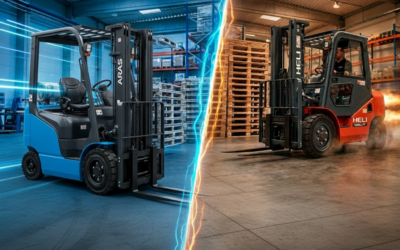
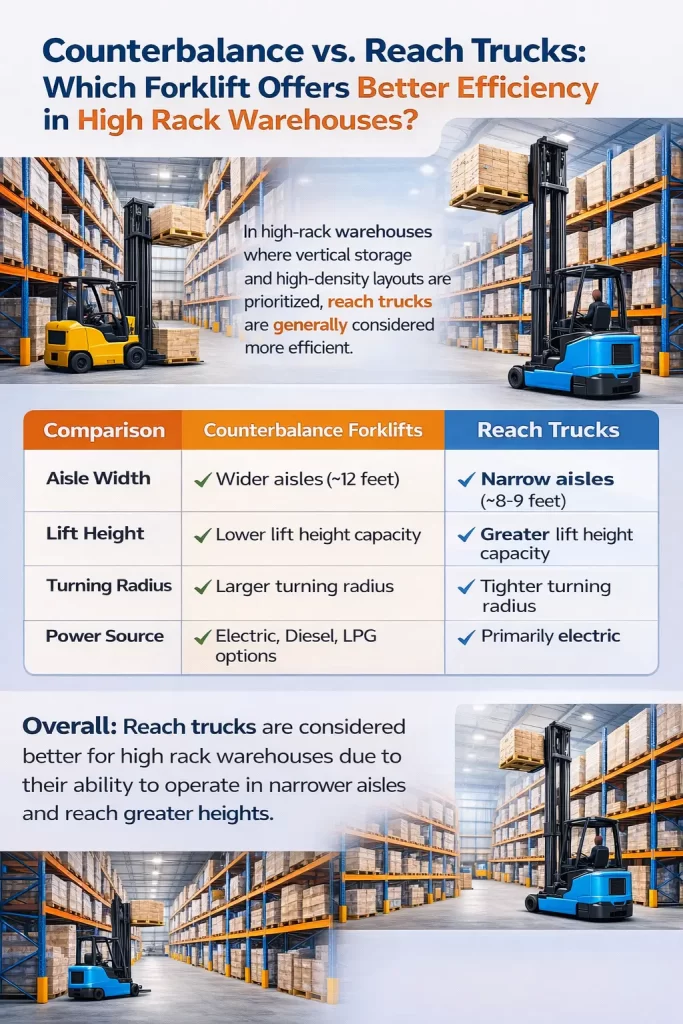
In high rack warehouses where vertical storage, narrow aisles, and high-density layouts are prioritized, the debate of Counterbalance vs Reach Trucks is usually won by the latter. Reach trucks are generally considered more efficient in these settings because they support greater lift heights, minimize aisle space, and significantly increase storage capacity within the same footprint.
Counterbalance forklifts remain highly valuable in operations that require versatility and outdoor performance. However, in strictly high rack environments, limitations in maneuverability and aisle width may reduce spatial efficiency.
Final Considerations
Before a decision is made, the following factors should be evaluated:
- Warehouse layout and aisle width
- Maximum rack height
- Load weight and dimensions
- Energy costs
- Maintenance capabilities
- Long-term operational goals
When equipment selection is aligned with warehouse design and storage objectives, measurable improvements in efficiency can be achieved.
Both forklift types play important roles in material handling operations. When evaluating counterbalance vs reach trucks, high rack warehouses focused on maximizing vertical storage often regard reach trucks as the more specialized and space-efficient solution.
Many warehouse planners also review operational insights and logistics best practices published by the Chartered Institute of Logistics and Transport when evaluating equipment strategies.