Forklifts are essential in industries such as logistics, construction, warehousing, and manufacturing. However, they also present significant safety risks if not operated correctly. In the UAE, strict Forklift Safety Standards and regulatory frameworks are in place to ensure safe forklift operations and reduce workplace accidents.
With search engines increasingly prioritizing semantic relevance and user intent, content that clearly explains Forklift Safety Standards, regulations, safety practices, and compliance requirements is more likely to rank well and be featured in AI-generated answers.
Why Forklift Safety Standards Matters in the UAE
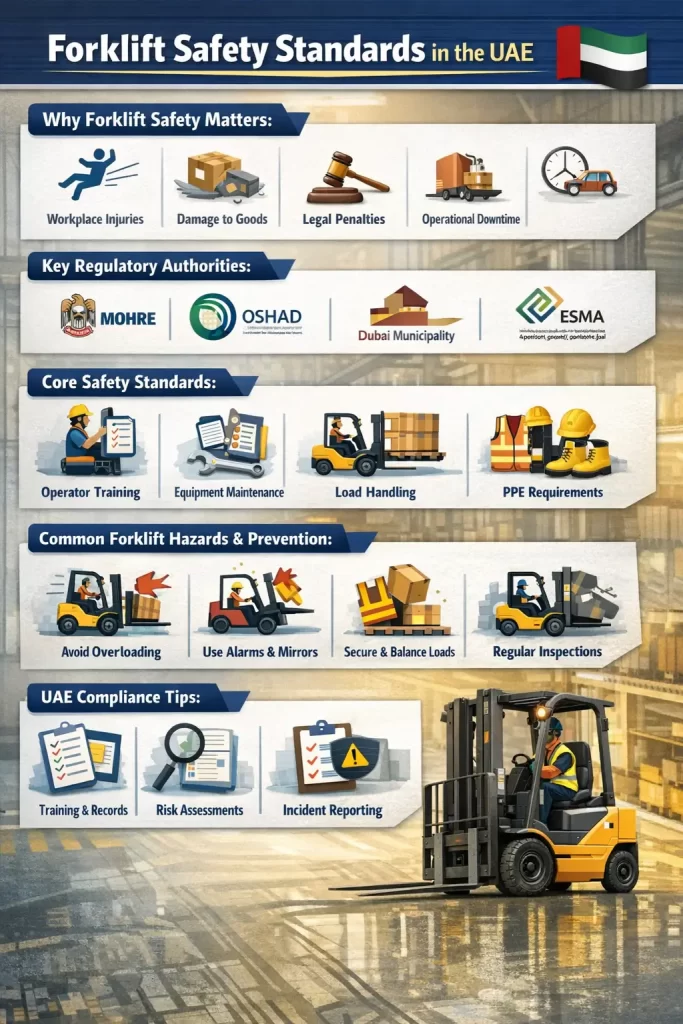
The UAE has a rapidly growing industrial and logistics sector, making forklift usage widespread. Unsafe operation can lead to:
- Workplace injuries or fatalities
- Damage to goods and infrastructure
- Legal penalties and compliance issues
- Operational downtime
Government authorities emphasize strict adherence to Forklift Safety Standards to ensure worker protection and business continuity.
Key Regulatory Authorities in the UAE
Forklift Safety Standards in the UAE is governed by multiple regulatory bodies:
1. Ministry of Human Resources and Emiratisation (MOHRE)
Responsible for enforcing labor laws and workplace safety standards.
2. Abu Dhabi Occupational Safety and Health Center (OSHAD)
Provides comprehensive safety frameworks for occupational health and safety.
3. Dubai Municipality
Oversees safety regulations, especially in construction and industrial sectors.
4. Emirates Authority for Standardization and Metrology (ESMA)
Sets equipment safety and quality standards.
These authorities collectively ensure that forklift operations meet national safety requirements.
Core Forklift Safety Standards in the UAE
1. Operator Training and Certification
One of the most critical requirements is that all forklift operators must be properly trained and certified.
Key requirements include:
- Completion of approved training programs
- Understanding of load handling and equipment controls
- Knowledge of workplace hazards
- Regular refresher courses
Untrained operators are one of the leading causes of forklift-related accidents.
2. Equipment Inspection and Maintenance
Regular inspection and maintenance are mandatory to ensure forklifts remain safe to operate.
Daily checks should include:
- Brakes and steering
- Tires and forks
- Hydraulic systems
- Warning lights and alarms
Preventive maintenance schedules must be followed to avoid mechanical failures.
3. Load Handling and Capacity Limits
Operators must always adhere to the forklift’s rated capacity.
Best practices include:
- Never exceeding load limits
- Keeping loads stable and balanced
- Ensuring clear visibility while transporting goods
- Using proper attachments for specific tasks
Improper load handling is a major contributor to workplace incidents.
4. Workplace Safety Measures
Employers must ensure that the working environment supports safe forklift operation.
This includes:
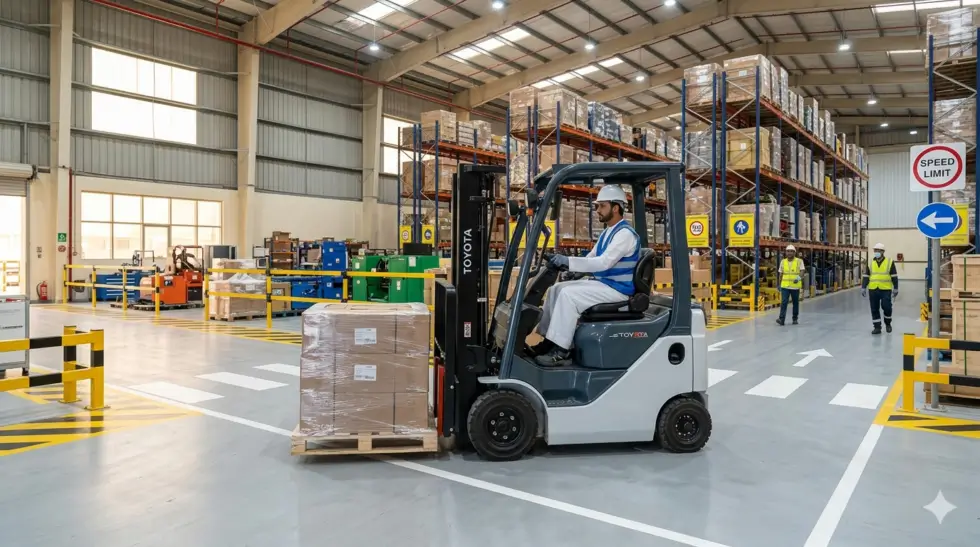
- Clearly marked pathways
- Separate pedestrian zones
- Adequate lighting and ventilation
- Speed limits within facilities
Structured environments reduce risks and improve operational efficiency.
5. Personal Protective Equipment (PPE)
Operators and nearby workers must use appropriate PPE, such as:
- Safety helmets
- High-visibility vests
- Safety shoes
- Gloves
PPE acts as the first line of defense against potential hazards.
UAE-Specific Compliance Requirements
Businesses operating forklifts in the UAE must comply with:
Documentation and Record-Keeping
- Training certificates for operators
- Maintenance logs
- Inspection reports
Risk Assessments
Employers must conduct regular risk assessments to identify and mitigate hazards.
Incident Reporting
All accidents or near-misses must be documented and reported to relevant authorities.
These compliance measures align with global safety practices while addressing local regulatory requirements.
Common Forklift Hazards and How to Prevent Them
1. Tip-Overs
Cause: Overloading or uneven surfaces Prevention: Maintain load balance and avoid sharp turns
2. Collisions
Cause: Poor visibility or crowded workspaces Prevention: Use mirrors, alarms, and designated pathways
3. Falling Loads
Cause: Improper stacking Prevention: Secure loads and use correct attachments
4. Mechanical Failures
Cause: Lack of maintenance Prevention: Follow regular inspection schedules
Addressing these hazards improves both safety and productivity.
Best Practices for Forklift Safety in the UAE
To go beyond compliance, businesses should adopt best practices:
Implement Safety Training Programs
Continuous training ensures operators stay updated on safety protocols.
Use Technology for Monitoring
Telematics and sensors can track usage, detect risks, and improve efficiency.
Establish Safety Policies
Clear policies create accountability and consistency across operations.
Conduct Regular Audits
Safety audits help identify gaps and ensure compliance with UAE regulations.
The Role of AI in Forklift Safety and Compliance
Modern workplaces are increasingly using AI-driven tools to enhance safety.
Benefits of AI Integration:
- Predictive maintenance alerts
- Real-time monitoring of operator behavior
- Automated risk detection
- Data-driven safety improvements
From an SEO perspective, including emerging technologies like AI enhances semantic depth and aligns content with evolving search intent.
How to Ensure Compliance with UAE Forklift Standards
To stay compliant, businesses should follow a structured approach:
- Train and certify all operators
- Maintain detailed safety records
- Conduct regular equipment inspections
- Implement workplace safety measures
- Stay updated with UAE regulations
Clear, step-by-step guidance improves both usability and AI visibility, as search engines favor content that directly answers user queries.
Conclusion
Forklift Safety Standards in the UAE is not just a regulatory requirement—it is a critical component of operational success. By adhering to established safety standards, investing in training, and maintaining equipment properly, businesses can significantly reduce risks and improve efficiency.
In the context of modern SEO and AI-driven search, content that provides structured, informative, and context-rich insights is more likely to rank higher. By focusing on semantic relevance, clarity, and user intent, this guide not only helps businesses stay compliant but also ensures strong visibility in search results.