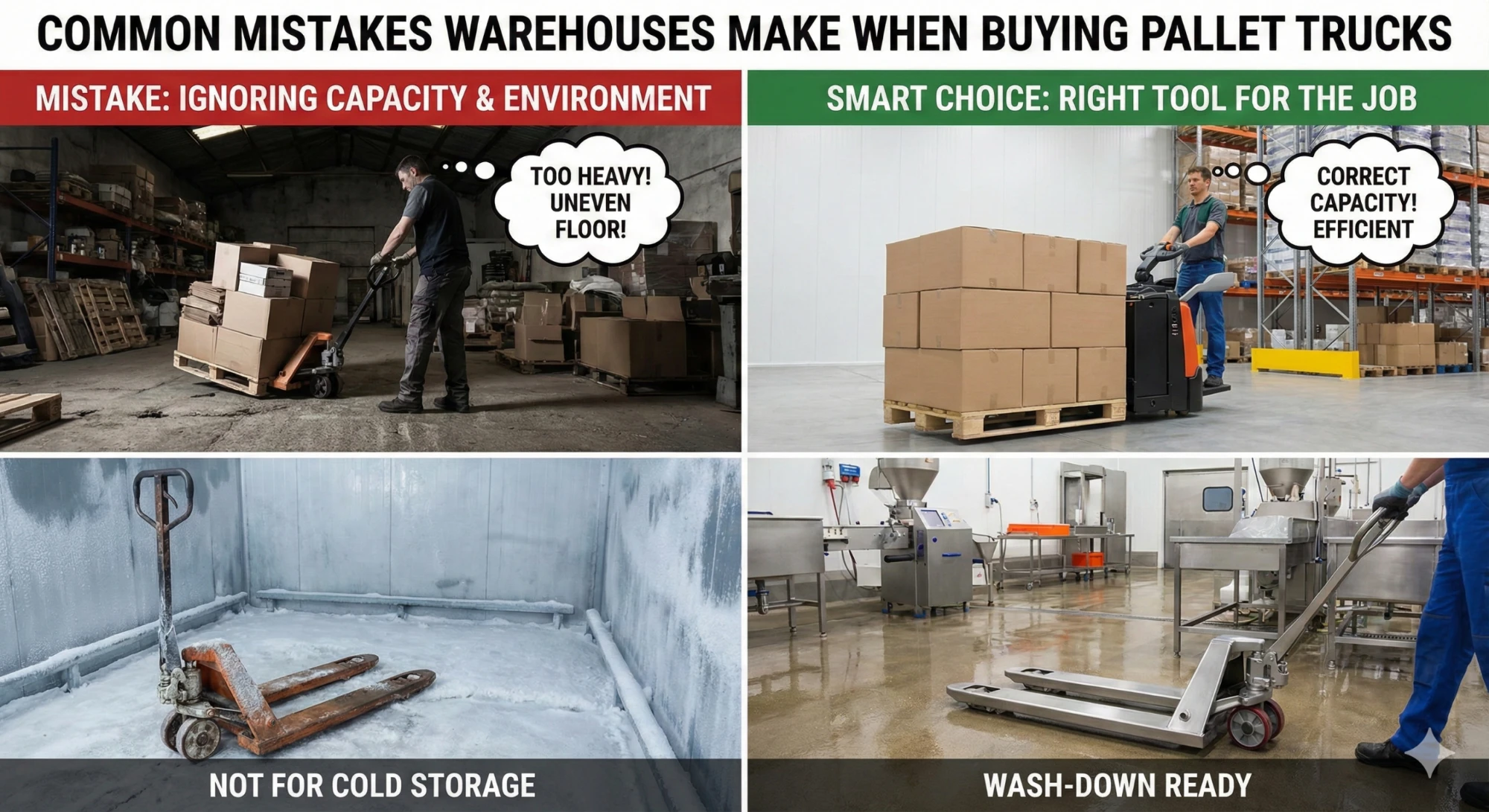
Choosing the right pallet truck should be simple. It’s a tool every warehouse relies on, and most teams buy them assuming any model will “do the job.” But that assumption is exactly why so many warehouses end up replacing trucks early, dealing with unexpected downtime, or fighting daily inefficiencies that could have been avoided with a more thoughtful purchase.
A pallet truck becomes part of the warehouse’s rhythm. It determines how easily workers move heavy loads, how safely goods travel from receiving to storage, and how smoothly daily operations run. When the wrong truck is chosen, the ripple effect shows up everywhere: product damage, worker strain, bottlenecks, and higher long-term operating costs.
Below are the most common mistakes warehouses make when buying pallet trucks, why they happen, and how you can avoid them with a more careful, context-driven selection process.
1. Underestimating Load Requirements
The most frequent (and most expensive) mistake is assuming that the listed lifting capacity on a truck matches the reality of your workload.
Warehouses often buy pallet trucks rated for 2,200 to 3,300 lbs. because those are the most common, lowest-cost models. The issue is that real-world loads aren’t static numbers. Pallets vary in size, weight distribution matters, and workers often push trucks to their limits without realizing it.
What happens when load requirements are underestimated:
- Wheels degrade rapidly under constant overweighting.
- Hydraulic pumps fail earlier than expected.
- Manual trucks require more force to start moving, increasing worker strain.
- Electric models drain batteries faster and perform inconsistently.
Even if the truck “can lift it,” operating near the upper limit every day dramatically shortens its lifespan.
How to avoid this mistake:
Assess the maximum load your team handles, not the average, and add a buffer. Warehouses that build in a 20 to 25% cushion generally see significantly longer equipment life, steadier performance, and fewer repair calls.
2. Ignoring Charging and Battery Infrastructure
Electric pallet trucks bring speed, comfort, and efficiency, but many warehouses adopt them without planning how charging will fit into daily operations.
This leads to predictable issues:
- Dead trucks during peak hours
- Charging stations are squeezed into unsafe or inconvenient corners
- Overuse of a single outlet or charger
- Frustration among teams who don’t know where to leave vehicles when batteries run low
In short, the truck is blamed for problems caused by the infrastructure.
How to avoid this mistake:
Work backwards from usage patterns.
Ask:
- When are trucks idle?
- How many are used simultaneously?
- Do workers run long routes or short, frequent ones?
- Do you have space for opportunity charging?
Planning charging like you would plan traffic flow ensures your electric trucks feel like an upgrade, not a complication.
3. Selecting the Wrong Truck Type for the Space or Load
A pallet truck that works beautifully in one warehouse can be a disaster in another. Mistakes usually stem from assuming all trucks are interchangeable.
Common mismatches:
- Long forks in narrow aisles: Trucks can lift but can’t maneuver.
- Wide trucks in dense racking: Workers bump pallets and scrape frames.
- Heavy electric trucks on delicate flooring: Floor surfaces develop grooves or cracks.
- Manual trucks used for high-frequency routes: Workers get fatigued faster, slowing productivity.
Each warehouse has its own layout, surfaces, pallet sizes, and handling patterns. Choosing a truck without considering these realities creates friction that never goes away.
How to avoid this mistake:
Study the physical environment as closely as you study the product specs.
Measure:
- Aisle width
- Turning radius
- Ramp angles
- Floor conditions
- Distance between common pickup and drop-off points
Walk the actual routes with a tape measure in hand. The right truck fits the environment the way a glove fits a hand: snug, predictable, and efficient.
4. Overlooking Ergonomics and Worker Comfort
When workers use pallet trucks for hours a day, small ergonomic differences become meaningful. Yet many purchases focus purely on price or capacity.
Neglecting ergonomics leads to:
- Wrist strain from poorly shaped handles
- Higher push/pull force on manual trucks
- Fatigue from trucks with uneven rolling resistance
- Awkward bending when fork heights don’t match common pallet styles
Comfort affects speed, safety, and morale. When equipment works with the body rather than against it, the whole warehouse moves more confidently.
How to avoid this mistake:
Let workers test options. Their feedback is the most accurate predictor of real-world satisfaction and long-term performance.
5. Assuming “Cheaper” Means “Better Value.”
A low sticker price is appealing, but pallet trucks are long-term tools. When a truck needs new wheels every few months, or when hydraulics fail early, the total cost of ownership grows far beyond the initial savings.
Common signs that a budget-first purchase backfires:
- Frequent service calls
- Spare parts becoming a recurring expense
- Workers avoiding certain trucks
- Replacement cycles closing in too quickly
How to avoid this mistake:
Compare trucks using long-term thinking: durability, parts availability, service intervals, and expected lifespan. A truck that lasts twice as long at a slightly higher price saves money, not costs more.
6. Not Including the Warehouse Team in the Decision
The people who handle pallets every day understand the process better than anyone. Yet decisions about equipment are often made by purchasing teams or managers without asking workers what they need.
This leads to mismatches between expectations and reality.
How to avoid this mistake:
Bring operators into the selection process. Their perspective ensures the chosen truck fits daily workflow instead of disrupting it.
Pre-Purchase Checklist for Choosing the Right Pallet Truck
Use this list during the evaluation process to make a confident, practical, warehouse-aligned decision.
Load & Capacity
- What is the heaviest pallet handled in normal operations?
- What is the acceptable safety buffer (20 to 25%) above that load?
- Are loads evenly distributed or off-center?
Environment & Layout
- Minimum aisle width?
- Turning radius required?
- Floor type (smooth, uneven, sensitive)?
- Are there ramps or inclines?
Usage Patterns
- Average distance traveled per shift
- Frequency of short vs. long routes
- Number of workers using the truck
Truck Type Fit
- Manual, semi-electric, or fully electric, based on workload
- Fork length compatible with pallet types
- Truck width compatible with environment
Battery & Charging (if electric)
- Do you have space for chargers?
- Do you need fast or opportunity charging?
- How many trucks need to charge at once?
Ergonomics & Comfort
- Handle comfort and grip
- Required push/pull force
- Ease of steering
- Visibility and control for electric models
Durability & Maintenance
- Expected lifespan under real workload
- Parts availability
- Warranty clarity
- Service response time
Team Feedback
- Have operators tested the truck?
- Did they identify any comfort or maneuverability issues?
Final Thoughts
Buying a pallet truck isn’t just a procurement task. It’s a decision that affects workers, workflows, safety, and operational efficiency every day. When warehouses take time to understand their environment, routes, loads, and team needs, they choose equipment that reduces strain, lasts longer, and keeps the entire operation running more smoothly.
Avoid the guesswork. See the ARAS electric pallet truck, hand pallet truck & scale and walkie electric pallet stacker, or browse the full product range.