A full 200 litre drum weighs somewhere around 200 to 250 kilograms, and it is an awkward shape to move. Tilting, lifting or decanting one by hand is how warehouse staff end up with back injuries, and a dropped drum of oil or chemical is a spill, a clean up and a safety report all at once.
Across the UAE, drums move constantly in lubricants, chemicals, paint and food liquid handling. Yet drum handling is often the last job in a warehouse still done by muscle, long after pallets have been mechanised. This is a short guide to picking the right tool for it.
Start with the movement, not the machine
There are only two questions that matter, and they sort the whole category.
Does the drum need to go up, or just along? Moving a drum across the floor and lifting one onto racking are different jobs and different machines.
Do you need to pour? Decanting means the drum has to rotate under control, which rules out the simplest tools.
The drum trolley: moving drums along the floor
A drum trolley clamps the drum, tilts it back and lets one person wheel it wherever it needs to go. No battery, no hydraulics, nothing to charge.
The Soosung SDP-300F handles standard 200 litre steel drums up to 300 kg, weighs only 90 to 100 kg itself, and runs on 250 mm front wheels with rotating rear castors. A second version, the SDP-300FS, adds a foot step lifting action that raises the drum 360 to 380 mm clear of the floor, which makes a real difference over thresholds and uneven surfaces.
This is the right answer when drums travel horizontally: from a delivery to a store, from a store to a production bay, around a workshop. It is also the cheapest way out of manual handling, which is why it tends to pay for itself the first time it prevents a dropped drum.
The drum lifter and stacker: getting drums up
Where a trolley shifts a drum across the floor, a lifter stacker is about the vertical job. Lifting a full drum onto racking, onto a spill pallet or up to a mixing station, and stacking drums instead of manhandling them up by hand.
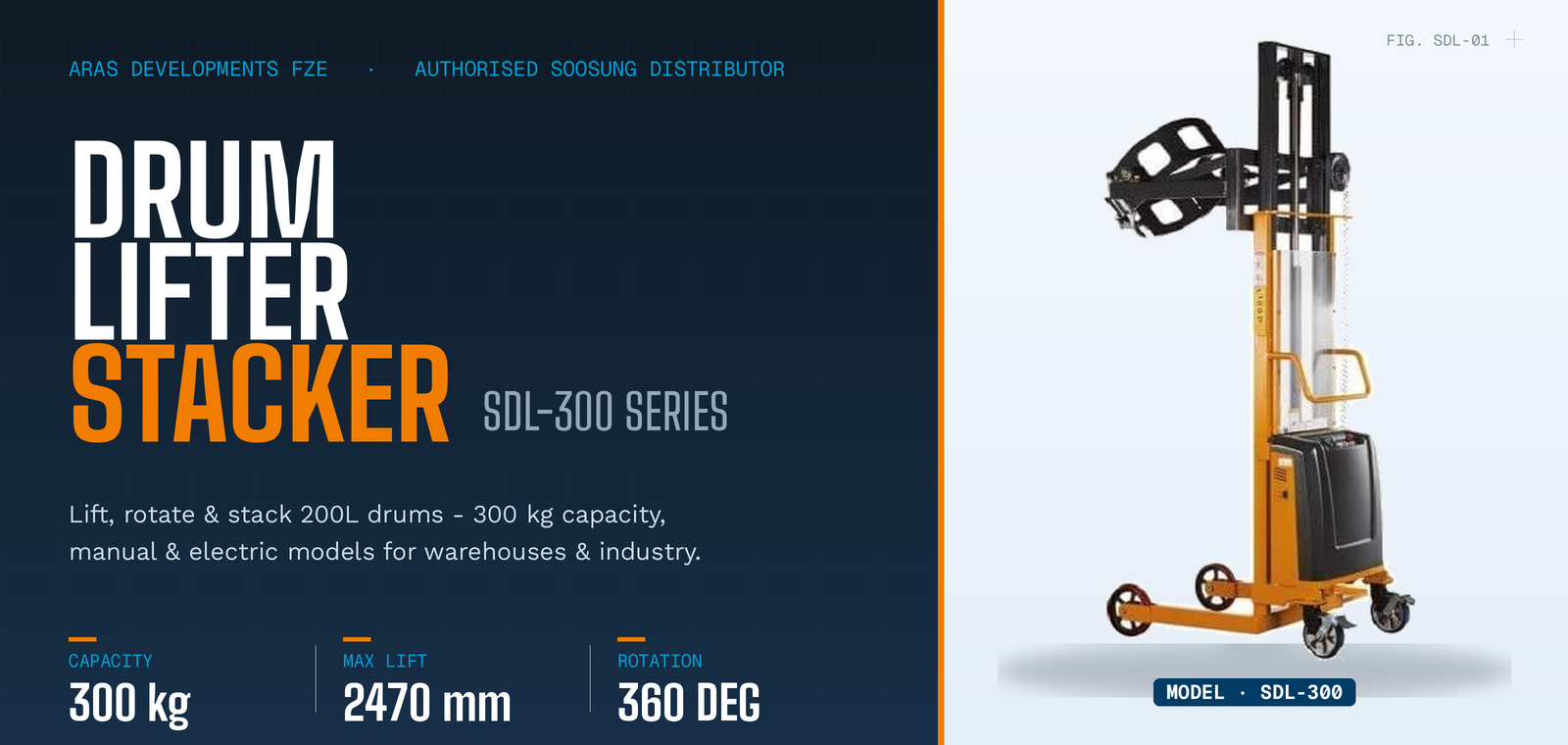
The Soosung SDL-300 series carries 300 kg and lifts to 2,470 mm on the high lift models, with a clamping head that rotates a full 360 degrees so drums can be poured and positioned under control. It comes in four configurations: SDL-300H and SDL-300HL are manual hydraulic, while SDL-300E and SDL-300EL are battery electric, running a DC 12V hydraulic motor with a 125Ah battery and an on board charger.
If you store drums on more than one level, or decant regularly, this is the version that removes the risky manual handling rather than just easing it. Anyone who has watched two people wrestle a 200 litre drum onto a second tier already knows the case for it.
Manual, hydraulic or semi electric
Within the lifting machines there is a second choice, and it comes down to frequency rather than weight.
For the occasional drum, a manual lifter is the cheapest answer and does the job. A hydraulic model takes the effort out of the lift itself, which helps when drums run heavier. A semi electric version powers the lift so the operator simply guides the drum into place, and that is the one to choose when drum handling is part of the daily routine rather than a now and then task. Spending a little more there usually pays back in speed and in fewer tired operators by the end of a shift.
The ARAS drum lifter range runs to 520 to 550 kg capacity across the YL520 and YL550 models, with a lifting speed of 120 mm per second, including versions with an integrated scale if you need to weigh as you handle.
Match the clamp to the drum
This is the detail that catches people out. Steel and plastic drums do not grip the same way, and a clamp set up for one can slip on the other.
Before you order anything, know three things: whether you handle steel, plastic or both, the drum capacity, and whether you need to tip and pour or just lift and move. Any supplier worth using will ask for these rather than sell you a unit that nearly fits.
Running both
Plenty of operations end up with two machines, and that is not over buying. A trolley for moving drums around, and a lifter stacker for getting them on and off racking or up to working height. They solve different problems and the trolley is cheap enough that pairing them is usually the sensible answer for any site handling drums daily.
Where this fits in the UAE
ARAS supplies drum handling equipment into chemical and paint stores, lubricant and oil distributors, food production lines, and the kind of mixed JAFZA distribution operations that receive goods on drums and then need to move them off a pallet, onto a stand, or up to a mixing tank.
ARAS Developments FZE is the authorised Soosung distributor in the UAE, with stock in JAFZA, Dubai and delivery across all seven emirates. Tell us your drum type, your weights and the heights involved, and we will match the clamp and the lift height to the job.
Frequently Asked Questions
How much does a full 200 litre drum weigh?
Around 200 to 250 kilograms once filled, depending on the contents. That is well beyond safe manual handling, which is why purpose built drum equipment exists.
What is the difference between a drum trolley and a drum lifter?
A trolley moves a drum horizontally across the floor. A lifter raises and stacks it, onto racking, spill pallets or mixing stations, and up to pouring height. If your drums need to go up as well as along, you need the lifter.
Can drum handling equipment take plastic drums as well as steel?
Yes, but the clamp has to suit the drum. Steel and plastic do not grip the same way and a clamp set up for one can slip on the other, so tell your supplier which you handle.
Do I need a powered drum lifter or will a manual one do?
For the occasional drum, manual is the cheapest answer and works. If drum handling is part of the daily routine, a semi electric lift is faster and leaves operators less tired at the end of a shift.
Do you deliver drum handling equipment across the UAE?
Yes. ARAS Developments FZE supplies drum trolleys, lifters and stackers from JAFZA, Dubai, with delivery across all seven emirates and genuine spare parts.