Most large facilities buy another forklift when what they actually need is a tow tractor. The two machines look like they compete and they barely overlap. One lifts, the other moves. Getting the distinction right can take a surprising amount of traffic out of a big site.
The question is distance, not weight
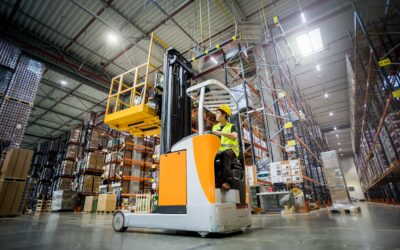
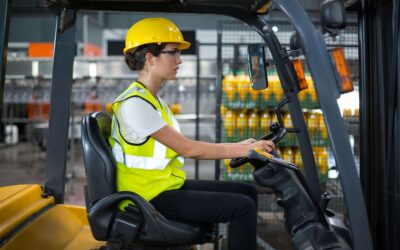
A forklift exists to lift a load and set it down somewhere else. It is very good at the vertical part and merely adequate at the horizontal part, because it carries one load at a time and it carries that load out in front, which limits speed and visibility.
A tow tractor, or tugger, does not lift anything. It pulls a train of loaded trolleys behind it. So instead of a forklift making ten separate trips between a production line and a dispatch dock, one tow tractor pulls the whole lot in a single run.
That is the entire logic. If your bottleneck is distance and repetition rather than lifting, you are looking at the wrong machine.
Signs your site is a tugger site
A few patterns come up again and again:
Your forklifts spend more time driving than lifting. If you watched one for an hour and it lifted three times and drove for forty minutes, that is a transport job.
The same route runs all day. Line side feeding, cross site transfers, goods in to a store, a store to a packing area. Repetition is what a tow tractor is built to exploit.
Loads are already on wheels, or easily could be. Carts, cages, kitting trolleys, baggage dollies. If the load has to come off a pallet at each end anyway, wheels change the whole picture.
Traffic is the problem. Several forklifts shuttling the same aisles creates congestion, near misses and pedestrian risk. One tugger making one run replaces several of those movements.
What the machines can pull
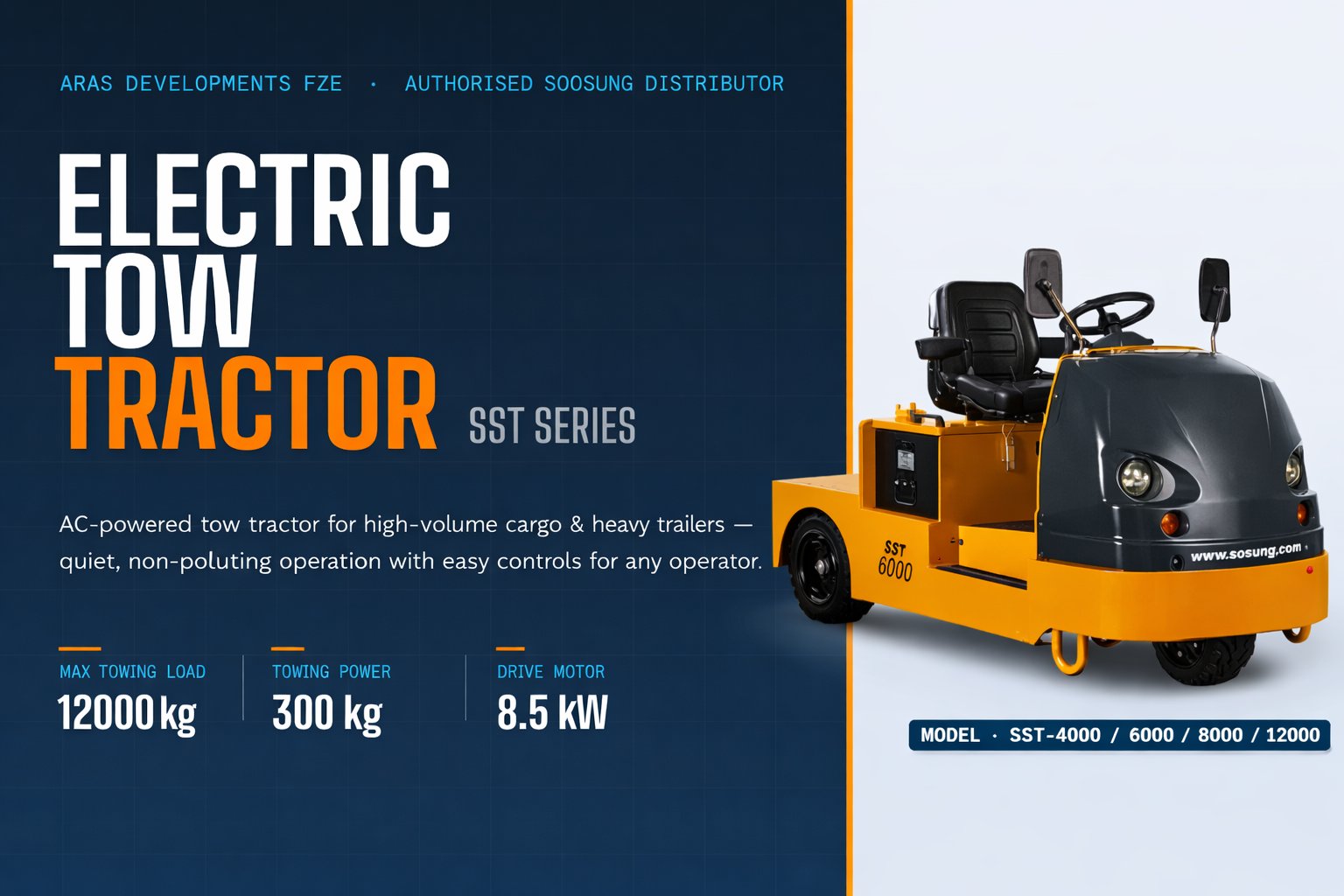
The Soosung SST series covers four towing grades, from 4,000 kg up to 12,000 kg. The SST-4000 and SST-6000 run solid tyres and suit indoor work, while the SST-8000 and SST-12000 use pneumatic tyres for heavier duty and rougher surfaces.
All four use an AC drive motor, up to 8.5 kW, which means clean and quiet running that works indoors and outdoors without ventilation concerns. Travel speeds run 6 to 10 km/h loaded and unloaded on the lighter models, and 8 to 12 km/h on the SST-12000.
Two details matter more than they sound. Electric power steering is available on the SST-4000 and SST-6000, which makes a long shift of tight turns much less tiring. And the FE.T fingertip throttle control gives smooth acceleration, which is what stops a train of trolleys snatching and shedding its load.
Where they earn their keep in the UAE
Airports and cargo handling are the obvious case, towing baggage carts, trailers and bulky cargo across terminals and yards. Manufacturing plants use them to move materials and components between production lines and storage. Large distribution centres run trailer trains to keep high volume operations moving.
The common factor is site size. A tow tractor rarely makes sense in a compact warehouse where nothing is more than sixty metres from anything else. It makes a lot of sense once your internal routes are measured in hundreds of metres and run all day.
Where a forklift is still the answer
Be honest about this, because a tugger bought for the wrong job sits idle. If your work is genuinely vertical, putting away to racking, loading and unloading vehicles, or picking at height, a forklift or reach truck is the right machine and a tow tractor will not help. The same goes for occasional or irregular movements. A tugger rewards routine.
Many sites end up running both, and that is usually correct. Forklifts at the ends of the route doing the lifting, a tow tractor doing the distance in between.
How to work out whether it fits
Do one simple exercise before you spend anything. Pick your busiest internal route, count how many trips a day are made along it, and note how many of those trips involve lifting at only one end. If most of them do, and the route is long, the case for a tugger will make itself.
ARAS Developments FZE is the authorised Soosung distributor in the UAE, supplying and servicing across all seven emirates. Tell us your routes and volumes and we will be straight with you about whether a tow tractor fits or whether another forklift is genuinely the better answer.
Frequently Asked Questions
What is an electric tow tractor used for?
It pulls trains of loaded trolleys or carts for horizontal transport, rather than lifting. It replaces multiple forklift shuttle trips along the same internal route with one run.
How much can a tow tractor pull?
The Soosung SST series covers four grades from 4,000 kg up to 12,000 kg of towing load, with solid tyres on the lighter models and pneumatic tyres on the heavy duty ones.
Is a tow tractor better than a forklift?
Neither is better, they do different jobs. A tow tractor wins where the bottleneck is distance and repetition. A forklift wins where the work is lifting, stacking or loading vehicles. Large sites often run both.
Can a tow tractor be used indoors?
Yes. The AC drive motor is clean and quiet with no emissions, so it works indoors and outdoors without ventilation concerns.
Do you supply tow tractors across the UAE?
Yes. ARAS Developments FZE supplies and delivers the Soosung SST electric tow tractor across all seven emirates, with on site service and genuine spare parts.