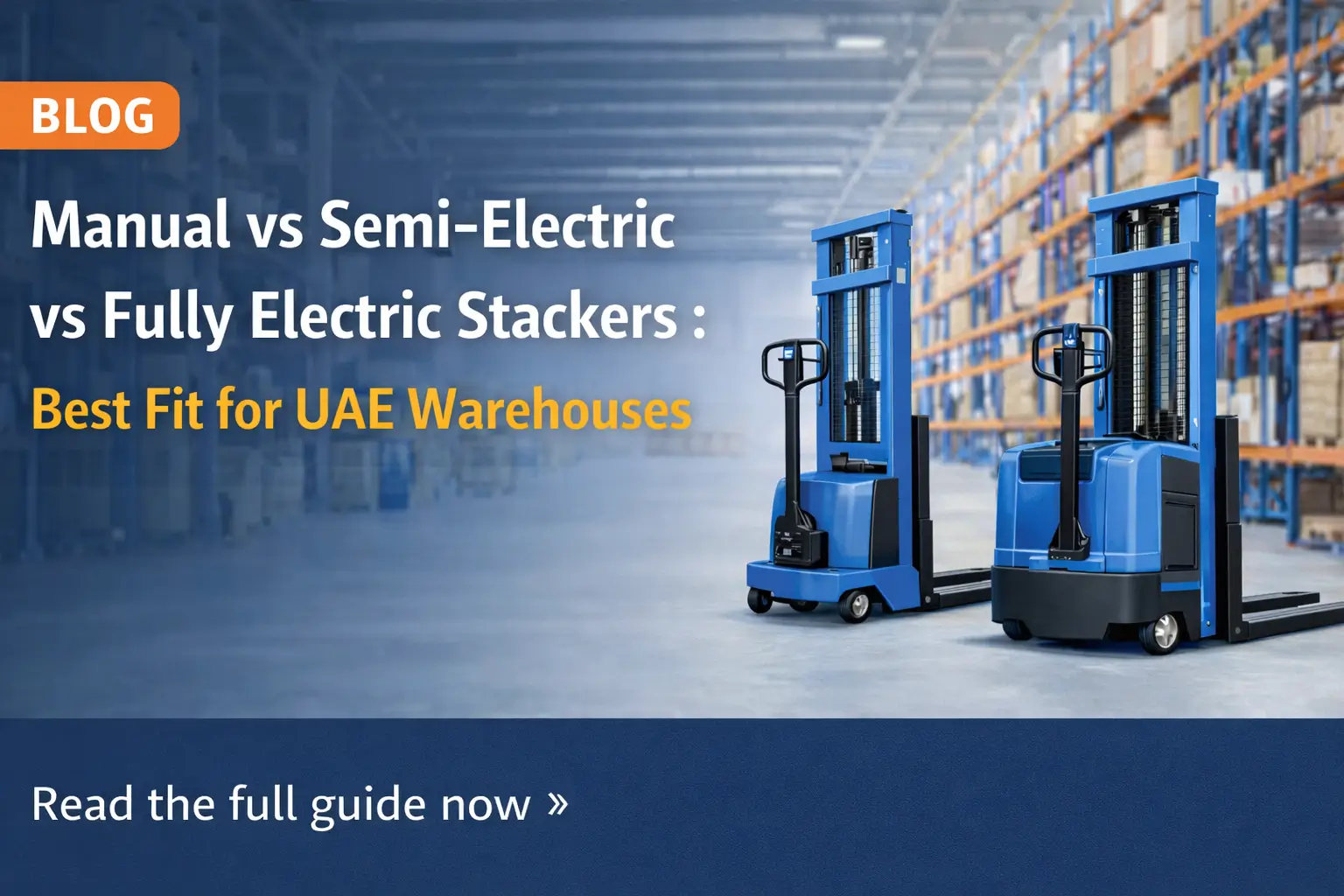
Manual vs Semi-Electric vs Fully Electric Stackers is a critical comparison for warehouse and logistics businesses aiming to optimize material handling efficiency and control operating costs. Choosing the right stacker depends on daily movement volume, load weight, lift height, and duty cycle. From small retail stockrooms to high-volume distribution centers, understanding the performance differences between Manual vs Semi-Electric vs Fully Electric Stackers ensures the right investment for long-term productivity and safety.
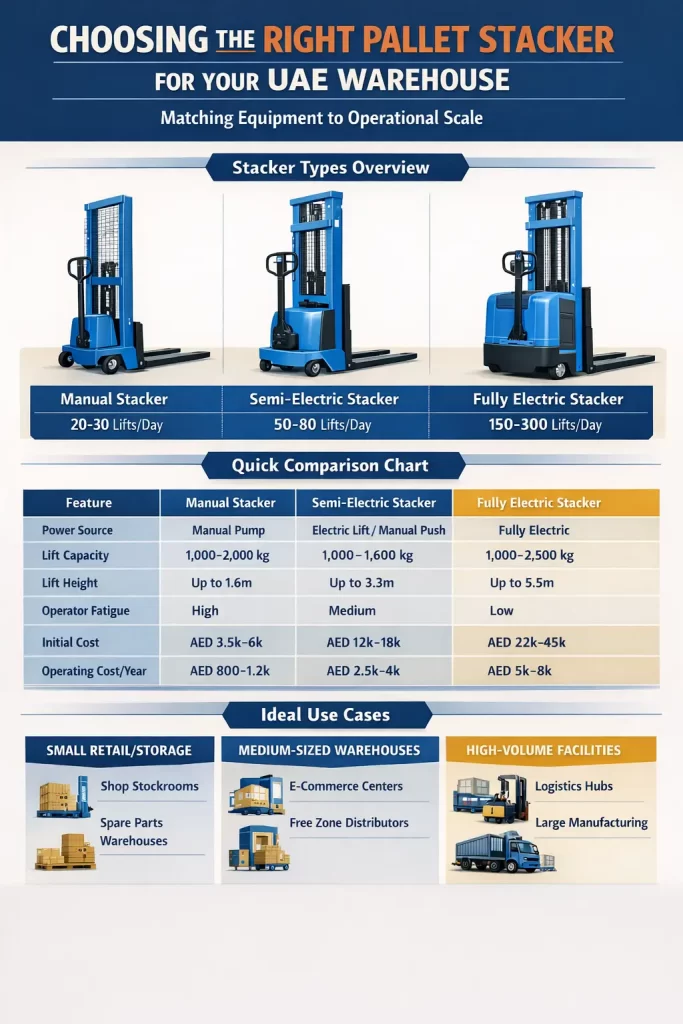
Selecting the right pallet stacker determines operational efficiency and long-term cost management in UAE warehouses. Manual stackers suit low-volume operations with 20-30 daily lifts, semi-electric models handle medium-duty cycles of 50-80 lifts, while fully electric stackers power high-intensity facilities requiring 150+ daily movements. The choice depends on lift frequency, load weights, operating hours, and available budget rather than equipment preference alone. The ongoing debate of Manual vs Semi-Electric vs Fully Electric Stackers continues to shape industry standards.
Quick Comparison between Manual vs Semi-Electric vs Fully Electric Stackers: Which Stacker Matches Your Operations?
| Feature | Manual Stacker | Semi-Electric Stacker | Fully Electric Stacker |
|---|---|---|---|
| Power Source | Manual hydraulic pump | Electric lift + manual push | Fully electric operation |
| Lifting Capacity | 1,000-2,000 kg | 1,000-1,600 kg | 1,000-2,500 kg |
| Lift Height | Up to 1.6m | Up to 3.3m | Up to 5.5m |
| Daily Duty Cycle | 20-30 lifts | 50-80 lifts | 150-300 lifts |
| Operator Fatigue | High (manual pumping) | Medium (pushing required) | Low (powered movement) |
| Initial Investment | AED 3,500-6,000 | AED 12,000-18,000 | AED 22,000-45,000 |
| Operating Cost/Year | AED 800-1,200 | AED 2,500-4,000 | AED 5,000-8,000 |
| Ideal Business Size | Small retail/storage | Growing warehouses | High-volume distribution |
| UAE Climate Impact | None | Battery affected by heat | Requires climate consideration |
Manual Stackers: Foundation Equipment for Small-Scale Operations
Manual pallet stackers rely entirely on operator effort through a hydraulic pump system for lifting and physical pushing for movement. These units serve businesses handling 20-30 pallet movements daily across short distances.
Load Capacity and Performance Specifications
Manual stackers typically handle loads between 1,000 kg and 2,000 kg. The lifting mechanism uses a foot-operated hydraulic pump that raises loads to maximum heights of 1.6 meters. Each pump stroke lifts the load approximately 50-80mm, requiring 15-20 pumps to reach full height with a 1,000 kg load.
Movement speed depends entirely on operator strength, averaging 2-3 km/h when pushing loaded pallets. Maneuvering in aisles wider than 2.5 meters presents minimal difficulty, but tighter spaces increase physical demands significantly.
Operational Cost Structure
The clarity in choosing between Manual vs Semi-Electric vs Fully Electric Stackers will ultimately lead to greater operational efficiency.
The total cost of ownership for manual stackers remains the lowest among all three types. Initial purchase prices range from AED 3,500 for basic models to AED 6,000 for heavy-duty variants with wider forks or higher lift capabilities.
Annual maintenance costs average AED 800-1,200, covering hydraulic fluid replacement, wheel bearing lubrication, and fork inspection. No electricity costs apply since the equipment requires no charging infrastructure.
Ideal Use Cases of Manual vs Semi-Electric vs Fully Electric Stackers in UAE Context
Manual stackers fit specific operational profiles in the UAE market. Small retail stores in Dubai and Abu Dhabi use these for receiving 5-10 pallets daily from delivery trucks. Storage facilities with infrequent pallet movements benefit from the zero operating cost between uses.
Temperature-controlled environments see reliable performance since no batteries suffer from extreme heat exposure. However, the physical demands limit operator productivity during summer months when warehouse temperatures exceed 35°C even with climate control.
Best suited for: Import/export trading offices, small retail stockrooms, pharmaceutical storage with limited daily movements, spare parts warehouses with sporadic activity patterns.
Semi-Electric Stackers: Balanced Solution for Medium-Volume Operations
Semi-electric stackers combine electric-powered lifting with manual propulsion, creating a middle ground between full manual effort and complete automation. The electric motor handles vertical movement while operators provide horizontal pushing force.
Technical Capabilities and Limitations
These units typically support loads from 1,000 kg to 1,600 kg with lifting heights reaching 3.3 meters. The electric lift motor operates from a 24V battery system, usually providing 4-6 hours of continuous operation before requiring recharge.
Lifting speed averages 80-100 mm per second with full load, completing a lift to 3 meters in approximately 30-35 seconds. This represents a significant time saving compared to manual pumping, which would require 2-3 minutes of physical effort for the same operation.
The manual push requirement means operators still expend energy moving loaded pallets horizontally. On smooth concrete floors common in JAFZA warehouses, a 1,200 kg load requires moderate effort to initiate movement and maintain 2-3 km/h travel speed.
Battery Performance in UAE Climate
The 24V lead-acid batteries used in semi-electric models face challenges in UAE’s summer temperatures. Optimal battery performance occurs between 20-25°C, but warehouse environments frequently reach 28-32°C even with air conditioning.
Heat exposure reduces battery capacity by 15-20% and shortens overall battery lifespan from the typical 1,200-1,500 charge cycles to 900-1,100 cycles. Facilities must implement dedicated charging areas with adequate ventilation to prevent thermal buildup during the 6-8 hour charging period.
Battery replacement costs range from AED 2,000-3,500 depending on capacity. With proper maintenance including monthly water level checks and equalization charging, batteries serve 2-3 years before requiring replacement.
In summary, businesses must evaluate their unique circumstances while considering Manual vs Semi-Electric vs Fully Electric Stackers.
Duty Cycle Recommendations
Semi-electric stackers handle 50-80 daily lift cycles effectively without overwhelming the battery system or creating excessive operator fatigue. This translates to operations receiving 2-3 container loads weekly or facilities processing 15-20 orders daily with average 3-4 pallets per order.
The equipment suits single-shift operations lasting 6-8 hours. Two-shift operations require either a second battery for hot-swapping or a second unit to maintain productivity during charging periods.
Best suited for: Medium-sized distributors in free zones, e-commerce fulfillment centers handling 500-1,000 orders monthly, manufacturing facilities with moderate raw material handling, cold storage operations with controlled access.
Fully Electric Stackers: High-Performance Solution for Intensive Operations
Fully electric pallet stackers eliminate all manual effort through powered lifting, propulsion, and steering systems. These machines serve high-volume facilities where productivity, speed, and operator comfort directly impact profitability.
Advanced Performance Specifications
Electric stackers support loads from 1,000 kg to 2,500 kg with lifting heights extending to 5.5 meters in specialized high-reach models. Dual motors provide separate power for lifting and travel functions, enabling simultaneous operations that save 15-20 seconds per cycle.
Travel speeds reach 4-6 km/h when loaded and 6-8 km/h when empty. Regenerative braking systems recapture energy during deceleration, extending battery runtime by 8-12%. Precision hydraulic controls allow operators to position loads within 10mm accuracy, critical for high-bay racking systems.
Walkie models feature an operator platform, while ride-on versions include a small standing platform that reduces fatigue during long-distance travel across large facilities. The transition from walkie to ride-on operation typically occurs when travel distances exceed 100 meters per cycle.
Power Systems and Energy Management
Modern fully electric stackers use either 48V lead-acid batteries or increasingly popular lithium-ion systems. Lead-acid batteries provide 5-7 hours of intensive operation from a single charge, while lithium-ion extends this to 8-10 hours with opportunity charging capabilities.
Lithium-ion batteries eliminate the 6-8 hour charging period required by lead-acid systems. A 1-hour opportunity charge during lunch breaks restores 40-50% capacity, enabling continuous operation across multiple shifts. The absence of maintenance requirements (no water refilling, no equalization cycles) reduces annual servicing costs by AED 1,500-2,000.
However, lithium-ion battery systems increase initial equipment costs by AED 8,000-12,000 compared to lead-acid equivalents. The investment pays back within 2-3 years through eliminated battery replacements and reduced maintenance labor.
Managing UAE Environmental Challenges
Fully electric stackers require active thermal management in UAE warehouse environments. Battery management systems should include temperature monitoring that reduces charging current when internal temperatures exceed 40°C.
Facilities operating in Jebel Ali, Dubai Industrial Park, or other free zones must provide climate-controlled charging areas. Even 2-3°C temperature reduction in charging zones extends battery lifespan significantly. Industrial exhaust fans positioned above charging stations prevent heat accumulation during peak summer months.
The advanced electronic controls in fully electric stackers also require protection from dust common in UAE environments. Regular cleaning of ventilation grilles and periodic compressed air blowing of control compartments prevents premature component failure.
Intensive Duty Cycle Capabilities
Fully electric stackers handle 150-300 daily lift cycles efficiently, making them essential for high-volume distribution centers, manufacturing facilities with just-in-time material delivery, and large retail operations processing dozens of container unloads weekly.
The equipment supports two-shift operations with lithium-ion batteries or requires a second battery for lead-acid systems. Three-shift operations demand lithium-ion technology exclusively since the rapid charging capability enables 24-hour productivity.
Best suited for: Major distribution hubs in JAFZA and DWC, third-party logistics providers handling multiple clients, large-scale manufacturing with continuous material flow, e-commerce giants processing thousands of daily orders, cold chain facilities requiring reliable performance.
Load Capacity Matrix: Matching Equipment to Material Types
Light-Duty Materials (500-800 kg average loads)
Manual Stacker: Adequate for packaged goods, cartons, light manufacturing components. Operator fatigue remains manageable with loads in this range across 20-30 daily cycles.
Semi-Electric Stacker: Overcapacity for typical loads but justified when lift heights exceed 2 meters or duty cycles reach 60+ lifts daily. The electric lift eliminates repetitive strain injuries.
Fully Electric Stacker: Cost-justified only when handling 100+ movements daily or when travel distances exceed 50 meters per cycle. The powered movement drastically reduces cycle times.
Medium-Duty Materials (800-1,500 kg average loads)
Manual Stacker: Maximum recommended weight for sustained operations. Operator rotation every 2-3 hours prevents exhaustion. Not recommended for UAE summer months in non-climate-controlled spaces.
Semi-Electric Stacker: Optimal capacity range. The electric lift handles weight efficiently while operators manage the pushing effort. Represents the sweet spot for this equipment class.
Fully Electric Stacker: Recommended when processing 50+ pallets daily in this weight range. The efficiency gains justify the higher investment when labor costs and productivity targets are calculated.
Heavy-Duty Materials (1,500-2,000 kg average loads)
Manual Stacker: Not recommended. Safety concerns increase dramatically. Operator effort becomes excessive, leading to shortcuts that compromise workplace safety.
Semi-Electric Stacker: Approaching capacity limits. Suitable only for infrequent heavy loads with predominantly lighter materials. Accelerated wear on push wheels and drive train expected.
Fully Electric Stacker: Strongly recommended. These loads demand powered movement. The investment protects operators from injury while maintaining productivity standards required in modern logistics operations.
Extra Heavy-Duty Materials (2,000-2,500 kg loads)
Manual Stacker: Completely inappropriate. Exceeds safe operating parameters.
Semi-Electric Stacker: Exceeds equipment specifications. Not designed for sustained operation at these weights.
Fully Electric Stacker: Only option. Requires heavy-duty models specifically rated for 2,500 kg capacity. Commonly used in steel product handling, automotive parts distribution, and heavy machinery component warehousing.
Duty Cycle Planning: Calculating Daily Operational Requirements
Low-Volume Operations (20-50 movements daily)
A small spare parts distributor in Dubai receives two supplier deliveries weekly (8-10 pallets each) and ships 15-20 orders daily with average 1-2 pallets per order. Total weekly movements: approximately 120-140 lifts.
Recommended equipment: Manual stacker for budgets under AED 10,000, or entry-level semi-electric stacker if lift heights exceed 2 meters or if growth projections indicate 50% volume increase within 18 months.
Cost analysis: Manual stacker costs AED 5,000 initial investment plus AED 1,000 annual maintenance. Over five years, total cost of ownership reaches AED 10,000. Semi-electric alternative costs AED 15,000 initially plus AED 3,500 annually (including one battery replacement), totaling AED 32,500 over five years. The AED 22,500 difference requires productivity gains or injury prevention justification.
Medium-Volume Operations (50-120 movements daily)
A pharmaceutical distributor in JAFZA processes 15-20 customer orders daily with 3-5 pallets per order, plus receives 3-4 supplier containers weekly requiring unloading and putaway of 60-80 pallets. Total weekly movements: 400-550 lifts.
Recommended equipment: Semi-electric stacker provides the necessary lifting capacity and duty cycle endurance. The electric lift eliminates operator fatigue that would occur with manual equipment at this volume.
Cost analysis: Semi-electric stacker costs AED 16,000 initially plus AED 17,500 over five years (maintenance, electricity, one battery replacement), totaling AED 33,500. Fully electric alternative costs AED 28,000 initially plus AED 27,000 over five years, totaling AED 55,000. The AED 21,500 premium for fully electric equipment remains difficult to justify unless labor shortages or operator retention issues exist.
High-Volume Operations (120-300 movements daily)
A third-party logistics provider in Dubai Industrial Park manages 8-12 client accounts, processing 40-60 orders daily with average 4-6 pallets per order, plus handles daily container receipts of 100-150 pallets. Total weekly movements: 1,500-2,000 lifts.
Recommended equipment: Fully electric stacker (walkie or ride-on depending on facility layout). The productivity gains, reduced cycle times, and operator comfort requirements justify the investment. Consider lithium-ion battery systems for facilities approaching 250+ daily movements.
Cost analysis: Fully electric stacker with lead-acid battery costs AED 30,000 initially plus AED 32,000 over five years (maintenance, electricity, two battery replacements), totaling AED 62,000. Lithium-ion version costs AED 40,000 initially plus AED 20,000 over five years (lower maintenance, no battery replacement), totaling AED 60,000. The lithium-ion option provides better total cost of ownership while delivering operational advantages.
Financial Decision Framework: ROI Calculation Methodology
Break-Even Analysis Across Equipment Types
Calculate the payback period when upgrading from manual to semi-electric equipment:
Labor productivity gain: Semi-electric stackers complete lifting cycles 60-75 seconds faster than manual pumping. At 60 daily cycles, this saves 60-75 minutes of productive time daily, equivalent to 12-15% productivity improvement.
Injury prevention value: Manual handling injuries cost UAE businesses an average AED 25,000-40,000 per incident (medical costs, lost time, temporary replacement labor). Semi-electric equipment reduces musculoskeletal strain injuries by approximately 70%.
Energy cost comparison: Semi-electric stackers consume AED 1,200-1,800 in electricity annually (assuming AED 0.35/kWh in Dubai). This added cost offsets partially against productivity gains.
Calculate the payback period when upgrading from semi-electric to fully electric equipment:
Cycle time reduction: Fully electric stackers complete full cycles 30-40% faster than semi-electric models due to powered travel. A facility processing 100 daily cycles saves 45-60 minutes daily, equivalent to 10-12% productivity gain.
Operator comfort and retention: In tight labor markets, the reduced physical demands improve operator retention. Recruiting and training replacement operators costs AED 8,000-12,000 per position. If fully electric equipment improves retention by preventing even one annual replacement, this offsets a significant portion of the cost premium.
Maintenance cost differential: Fully electric stackers require more sophisticated maintenance but eliminate manual push wheel replacement (common wear item on semi-electric units). The net difference averages AED 1,500-2,000 higher annual costs.
## Contact ARAS Development FZE for exact pricing of products
Total Cost of Ownership Comparison of Manual vs Semi-Electric vs Fully Electric Stackers ## (5-Year Period)
Manual Stacker:
- Initial investment: AED 5,000
- Annual maintenance: AED 1,000 × 5 years = AED 5,000
- Energy costs: AED 0
- Expected parts replacement: AED 1,500
- Total: AED 11,500
Semi-Electric Stacker:
- Initial investment: AED 16,000
- Annual maintenance: AED 2,800 × 5 years = AED 14,000
- Energy costs: AED 1,500 × 5 years = AED 7,500
- Battery replacement (year 3): AED 2,800
- Expected parts replacement: AED 2,200
- Total: AED 42,500
Fully Electric Stacker (Lead-Acid):
- Initial investment: AED 30,000
- Annual maintenance: AED 4,000 × 5 years = AED 20,000
- Energy costs: AED 2,800 × 5 years = AED 14,000
- Battery replacements (years 2.5 and 5): AED 7,000
- Expected parts replacement: AED 3,500
- Total: AED 74,500
Fully Electric Stacker (Lithium-Ion):
- Initial investment: AED 40,000
- Annual maintenance: AED 2,500 × 5 years = AED 12,500
- Energy costs: AED 3,200 × 5 years = AED 16,000
- Battery replacement: AED 0 (10-year warranty)
- Expected parts replacement: AED 2,800
- Total: AED 71,300
Operational Scenario Analysis: Real-World Applications
Scenario 1: Growing E-Commerce Business in Sharjah
Current state: Processing 25 orders daily with 2-3 pallets each using a manual stacker. Operations limited to 6 hours daily due to operator fatigue. Growth projections indicate 60-80 orders daily within 12 months.
Recommendation: Invest in a semi-electric stacker immediately. The manual equipment will become a bottleneck within 6-9 months. The semi-electric unit provides room for growth to 80-100 daily movements before requiring upgrade to fully electric equipment.
Implementation approach: Purchase semi-electric stacker now while using existing manual stacker as backup equipment. This provides redundancy during maintenance periods and handles occasional volume spikes during peak seasons.
Scenario 2: Automotive Parts Distributor in JAFZA
Current state: Processing 80-100 daily pallet movements using two semi-electric stackers. Experiencing battery limitations during afternoon shift as units run out of charge by 3:00 PM. Second battery costs and storage space limit charging infrastructure expansion.
Recommendation: Replace one semi-electric unit with fully electric stacker equipped with lithium-ion battery. The single lithium-ion unit can handle 60-70% of daily volume through opportunity charging during break periods. Retain one semi-electric unit for backup and overflow handling.
Implementation approach: Phase replacement over two budget cycles. The productivity gains from the fully electric unit will become immediately apparent, justifying second unit replacement in following year.
Scenario 3: Cold Storage Facility in Dubai
Current state: Operating at -18°C to -22°C with manual stackers. Operators rotating every 90 minutes due to combined physical effort and cold exposure. Processing 40-50 daily movements. Safety concerns increasing as physical demands in extreme cold create injury risks.
Recommendation: Upgrade to fully electric stacker with cold-storage specification. The powered movement eliminates physical exertion that compounds cold exposure effects. Cold-rated models feature sealed electrical components and specialized hydraulic fluids functional to -25°C.
Implementation approach: Single fully electric unit rated for cold storage operations. The investment protects operator safety while improving productivity. Cold-storage models cost AED 5,000-8,000 more than standard units but prevent the alternative expense of frequent operator rotation and potential cold-stress injuries.
Maintenance Requirements Across Equipment Types
Manual Stacker Maintenance Schedule
Monthly tasks: Visual inspection of hydraulic pump, fork condition check, wheel bearing lubrication. Time required: 30 minutes. Cost: AED 50-80 in lubricants and minor supplies.
Quarterly tasks: Hydraulic fluid level check, handle grip condition assessment, safety label visibility verification. Time required: 45 minutes. Cost: AED 80-120.
Annual tasks: Complete hydraulic system service including fluid replacement, fork structural integrity inspection, wheel replacement if wear exceeds 40%. Time required: 2-3 hours. Cost: AED 800-1,200 including labor.
Common wear items include push wheels (replacement every 18-24 months, AED 400-600 per set) and hydraulic seals (replacement every 3-4 years, AED 300-500 including labor).
Semi-Electric Stacker Maintenance Schedule
Weekly tasks: Battery water level check (lead-acid systems only), visible damage inspection, operator function test. Time required: 15 minutes. Cost: Negligible.
Monthly tasks: Battery terminal cleaning, drive wheel condition assessment, lift chain lubrication, emergency stop function verification. Time required: 60 minutes. Cost: AED 100-150.
Quarterly tasks: Battery equalization charge cycle, electrical connection tightness verification, brake function testing, complete safety system check. Time required: 90 minutes plus 8-hour equalization cycle. Cost: AED 200-300.
Annual tasks: Complete electrical system inspection, hydraulic component service, drive motor brush inspection, battery load test, lift chain replacement if elongation exceeds 2%. Time required: 4-5 hours. Cost: AED 2,000-3,000 including labor and typical parts.
Critical wear items include drive wheels (replacement every 12-18 months under intensive use, AED 800-1,200 per set), lift chains (replacement every 2-3 years, AED 600-900), and batteries (replacement every 2-3 years, AED 2,000-3,500).
Fully Electric Stacker Maintenance Schedule
Weekly tasks: Visual inspection of electrical components, operator control function test, emergency stop verification. Time required: 20 minutes. Cost: Negligible.
Monthly tasks: Drive and lift motor inspection, hydraulic fluid level check, brake system assessment, battery connection inspection. Time required: 90 minutes. Cost: AED 150-250.
Quarterly tasks: Complete electrical system diagnostic scan, motor bearing lubrication, hydraulic filter replacement, battery capacity test, control system calibration verification. Time required: 2-3 hours. Cost: AED 400-600.
Annual tasks: Comprehensive system inspection including motor brush replacement, hydraulic system overhaul, electrical control board testing, brake component replacement, lift chain inspection and adjustment. Time required: 6-8 hours. Cost: AED 3,500-5,000 including labor and standard parts.
Major wear items include traction motor brushes (replacement every 1,800-2,200 operating hours, AED 400-600), hydraulic pump components (overhaul every 3,000-3,500 hours, AED 1,200-1,800), and drive wheels (replacement every 2,400-3,000 hours, AED 1,500-2,200 per set).
Lithium-ion battery systems eliminate weekly water checks and quarterly equalization cycles, reducing maintenance labor by approximately 40 hours annually valued at AED 1,600-2,000.
Making the Final Decision: Equipment Selection Checklist
Evaluate Your Operational Parameters
Daily movement volume:
- Under 30 lifts → Manual stacker sufficient
- 30-80 lifts → Semi-electric stacker recommended
- 80-150 lifts → Semi-electric stacker required, consider fully electric
- 150+ lifts → Fully electric stacker required
Average load weight:
- Under 800 kg → All equipment types suitable based on volume
- 800-1,500 kg → Semi-electric minimum for volumes above 40 daily lifts
- 1,500-2,000 kg → Fully electric strongly recommended
- Over 2,000 kg → Fully electric required, heavy-duty specification
Maximum lift height required:
- Under 1.5m → Manual stacker adequate for low volumes
- 1.5-2.5m → Semi-electric stacker recommended
- 2.5-4.0m → Fully electric stacker recommended
- Over 4.0m → Fully electric stacker required, possibly high-reach model
Typical travel distance per cycle:
- Under 20 meters → Manual effort acceptable for low volumes
- 20-50 meters → Semi-electric suitable with moderate volumes
- 50-100 meters → Fully electric recommended for efficiency
- Over 100 meters → Fully electric with ride-on platform required
Operating environment:
- Climate-controlled warehouse → All equipment types suitable
- Non-climate-controlled UAE facility → Avoid manual stackers during summer months; semi-electric and fully electric require heat management
- Cold storage below 0°C → Fully electric with cold-specification required
- Outdoor/mixed environment → Fully electric with weather protection required
Calculate Your Justification Metrics
Productivity requirements: If cycle time reductions of 20% or more directly impact revenue (order fulfillment capacity, container unloading speed affecting detention fees), fully electric equipment justifies investment through measurable gains.
Labor market conditions: Tight labor markets in UAE free zones where operator recruitment costs exceed AED 10,000 per position favor equipment that improves retention through reduced physical demands. Factor operator turnover costs into equipment selection.
Safety and compliance: Facilities with active safety programs measuring lost-time injuries should value equipment that reduces musculoskeletal strain risks. Insurance premium reductions and avoided incident costs often justify equipment upgrades.
Growth trajectory: Operations projecting 30-50% volume growth within 24 months should purchase equipment sized for future needs rather than current requirements. The productivity disruption and expense of premature equipment replacement exceeds the carrying cost of slightly oversized equipment.
Available capital: Businesses with limited capital access should prioritize manual or semi-electric options rather than financing fully electric equipment beyond operational justification. Equipment lease options (typically 36-48 months) provide alternative financing structures when outright purchase exceeds budget.
Partner with ARAS for Optimal Equipment Selection
ARAS Developments FZE serves UAE businesses from our JAFZA facility with comprehensive stacker solutions across all three equipment categories. Our team analyzes your specific operational requirements including volume patterns, load characteristics, facility layout, and budget constraints to recommend the precisely matched equipment.
We maintain inventory of manual stackers from AED 4,200, semi-electric models from AED 14,500, and fully electric stackers from AED 26,000. All equipment includes warranty coverage, operator training, and ongoing maintenance support.
Our Soosung partnership delivers Korean-manufactured equipment engineered for reliability in Middle East operating conditions. Service response within 24 hours across Dubai, Sharjah, and Abu Dhabi ensures minimal downtime.
Contact ARAS Developments FZE at +971 4 887 6602 or sales@arasfze.com to schedule a site assessment. Our material handling specialists evaluate your operations and provide detailed equipment recommendations with transparent cost analysis supporting informed purchasing decisions.
Related Equipment: Electric Pallet Trucks | Reach Stackers | Forklift Rental Services
For industry safety standards and material handling best practices, refer to the Occupational Safety and Health Administration (OSHA) guidelines on powered industrial trucks and warehouse equipment operations.
When investing in equipment, businesses must analyze the advantages of Manual vs Semi-Electric vs Fully Electric Stackers for their specific needs.
The right choice between Manual vs Semi-Electric vs Fully Electric Stackers can significantly impact warehouse productivity and safety.