Nobody asks this question before they hire. Everybody asks it at eleven o’clock on the morning it happens, usually with a container waiting outside. It is worth five minutes of thought beforehand, because the answer varies enormously between suppliers and it is the part of a rental agreement most likely to cost you money.
The three questions that matter
When a hired machine stops, only three things decide how bad the day gets. Who pays for the repair. How quickly someone arrives. And what happens if it cannot be fixed today.
A rental agreement that answers all three clearly is worth more than one that is a few hundred dirhams cheaper per month.
Who pays for the repair
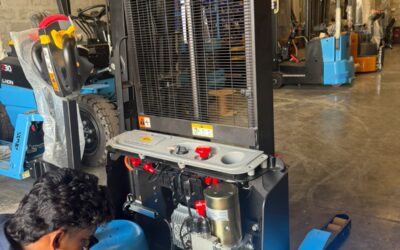
On an ARAS rental, servicing sits with ARAS. Preventive maintenance, safety inspections and prompt servicing are inside the monthly figure, so a breakdown is the supplier’s problem to fix rather than a bill you were not expecting.
That is the arrangement you want, and it is not universal. Some hire agreements pass repair costs back to the hirer beyond a threshold, or bill for callouts separately. When you compare two rental quotes, this is the line to compare, not the headline rate.
The exception in every agreement is damage rather than wear. A hydraulic seal that fails is the supplier’s cost. A mast bent by driving into racking is not. That distinction is fair, but it should be written down before the machine arrives rather than argued about afterwards.
How quickly someone arrives
Ask for a number in hours, and ask what it means outside working hours. ARAS publishes 24/7 emergency response for material handling equipment, and routine quotations within 24 hours.
Two practical points make a real difference to that response time. The first is where the supplier is based and whether they genuinely cover your emirate. The second is where the parts sit. A technician who arrives quickly and then waits three weeks for a part has not solved your problem.
What happens if it cannot be fixed today
This is the question most hirers forget to ask, and it is the one that protects your operation rather than your budget.
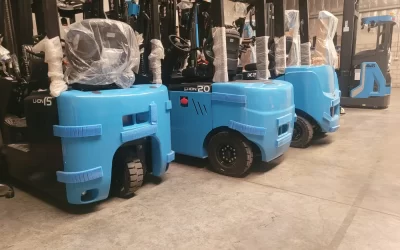
On the ARAS rental fleet, where a truck cannot be repaired quickly, the replacement is sorted out. That matters more than the repair itself. A machine under repair is an inconvenience. A machine under repair with no replacement is a stopped operation, and the cost of that lands on you within hours.
Be clear that this is a feature of renting rather than of servicing in general. If you own the truck and hold a service contract, that contract covers the repair, not a stand-in machine. Cover for downtime on an owned fleet is something to arrange separately, and it is one of the better arguments for renting the machine your operation cannot do without.
When you are comparing hire terms, ask directly: if this truck is off the road for a week, do I get another one, and how fast? Then get the answer in writing.
What you can do to make breakdowns rarer
Some of this is in your hands, and it costs nothing.
Report the small things
A noise, a slow lift, a brake that feels different. Operators often live with a symptom for weeks because the truck still works. Almost every expensive failure announces itself first.
Do the daily checks
Forks, tyres, hydraulics, horn, lights, brakes. Five minutes at the start of a shift catches most of what turns into a callout, and it is also a safety requirement rather than a nicety.
Match the machine to the work
A lot of breakdowns are really the wrong specification. A truck rented at the edge of its capacity, or a cushion tyre machine working an uneven yard, will fail more often than one specified properly. If the job has changed since you hired, say so.
Charge properly
On electric machines, poor charging habits shorten battery life more than anything else. If your shift pattern does not suit the battery you have, that is worth raising, because lithium machines carry a higher rate but run longer days without a swap.
The short version
Before you sign a rental agreement, get four answers: who pays for repairs, what counts as damage rather than wear, how fast a technician arrives and at what hours, and whether you get a replacement machine if the repair runs long. If your supplier is comfortable putting those in writing, you are in good hands.
ARAS rents electric forklifts, reach trucks, stackers and pallet trucks from Jebel Ali Free Zone with delivery across all seven emirates, and servicing included on every rental. Tell us the load, the lift height and the hours of use and we will come back with a delivered price the same working day.
Frequently Asked Questions
Who pays to repair a rented forklift in the UAE?
On an ARAS rental, servicing sits with ARAS. Preventive maintenance, safety inspections and prompt servicing are included in the monthly figure, so a breakdown is not a separate bill. Damage caused by misuse is treated differently from normal wear.
Do I get a replacement if my rented forklift cannot be repaired?
On the ARAS rental fleet, where a truck cannot be repaired quickly, a replacement is arranged. This applies to rented machines. A service contract on a forklift you own covers the repair rather than a stand-in truck.
How fast will a technician come out to a breakdown?
ARAS publishes 24/7 emergency response, with routine quotations provided within 24 hours.
What is not covered on a forklift rental?
Damage rather than fair wear is the usual exception, for example a mast damaged by an impact. Agree the boundary in writing before the machine is delivered.
Does ARAS cover breakdowns outside Dubai?
Yes. ARAS Developments FZE is based in Jebel Ali Free Zone and delivers and services across all seven emirates.